
Open Ocean Project

Transforming ocean management by
making the invisible visible

When it comes to ocean governance, there lies a simple truth:

We can't manage what we can't see.

Svg Vector Icons : http://www.onlinewebfonts.com/icon

Most of the ocean has gone unobserved and unmapped—a world of unknown. And without a comprehensive picture of what goes on beyond the horizon, we are powerless to make meaningful change.

But satellites are giving us eyes from space.

Now, under the open ocean project, we will use these satellites to shine a light on all industrial human activity at sea–and make it freely available to the world.

Svg Vector Icons : http://www.onlinewebfonts.com/icon
100%
Industrial fishing vessels
100%
Non-fishing vessels
100%
Fixed infrastructure
100,000s
Small-scale fishing boats

Operating in the Dark

While detailed maps of nearly every land area on the planet exist, we simply do not have the same information about the marine domain—there’s no comprehensive map of fishing, shipping or infrastructure. 

In this data void, it is all too easy to do harm to the environment, mismanage marine resources or disregard the law—and get away with it. Ocean managers, government authorities and conservationists are operating in the dark.

Until now.

Making the Invisible 

Visible

An explosion in artificial intelligence and the availability of satellite data are making it possible to map the ocean like never before. The number of remote-sensing satellites continues to dramatically grow each year, providing imagery of even the most remote parts of the ocean in near-real time. Advances in machine learning and cloud computing allow us to translate these billions of data points into understandable information. 

This exciting technology offers the opportunity to create a “digital ocean”–an interactive online map that publicly reveals all industrial human activity at sea. We call it the open ocean project and it has the power to transform how we view the ocean—and protect it.

Bringing the Ocean into Focus

We will process millions of gigabytes of satellite data to map and monitor industrial activity at sea, including all industrial fishing vessels, hundreds of thousands of small-scale fishing boats, and all large non-fishing vessels like cargo ships, cruise liners and oil tankers. We will also reveal all oil and gas rigs, mining and other fixed infrastructure like aquaculture pens and ocean wind farms. We will build a picture of what is being done across the ocean, where and by whom. And we’ll make this knowledge available for anyone to use.

September
2025
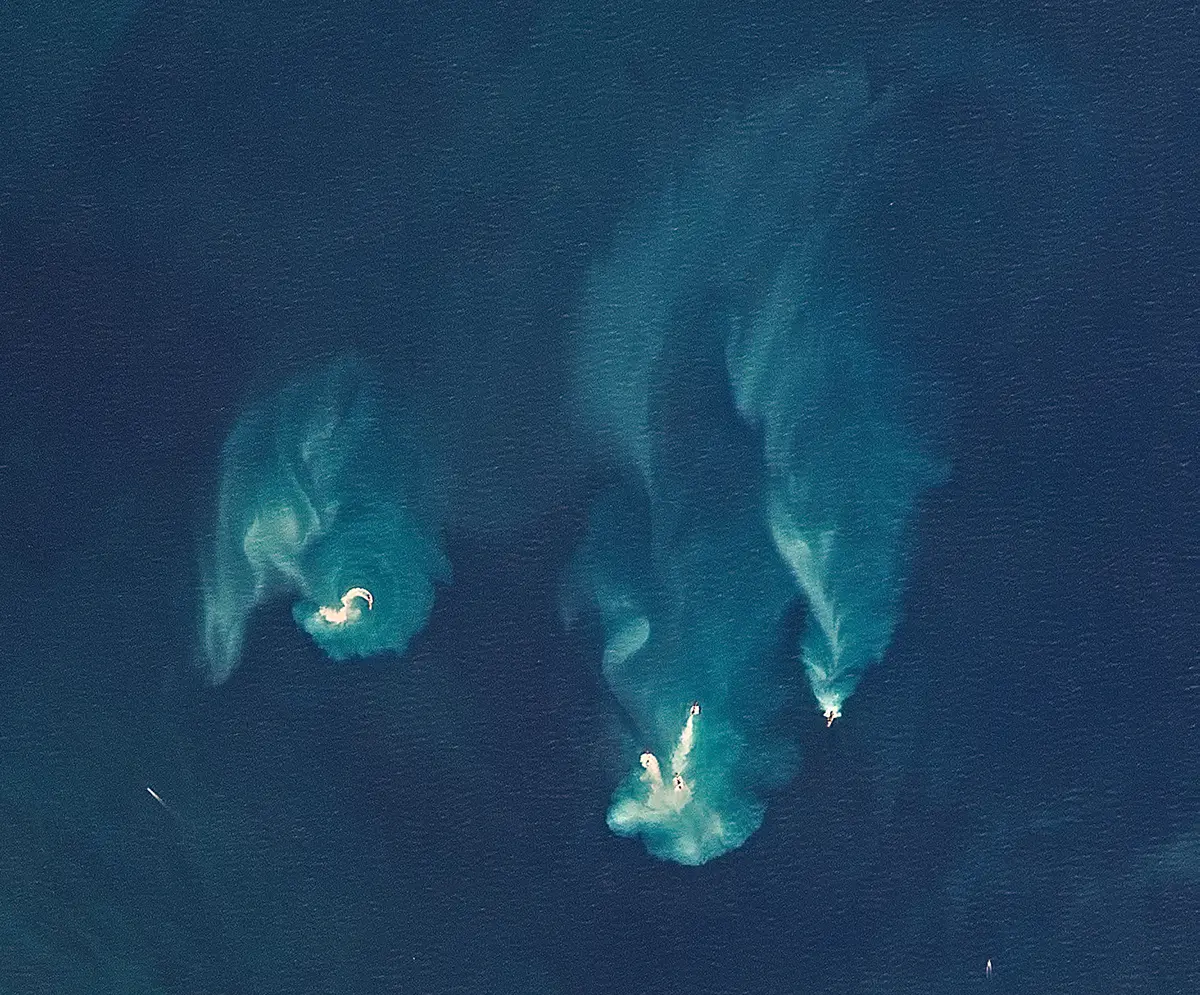
Satellite view of three small ships in dark blue ocean, each surrounded by swirling light blue and turquoise plumes, showing sediment movement in the water.

High-resolution optical imagery from Planet is expanding views and leading to significant advances in vessel detections around the globe.
July
2025
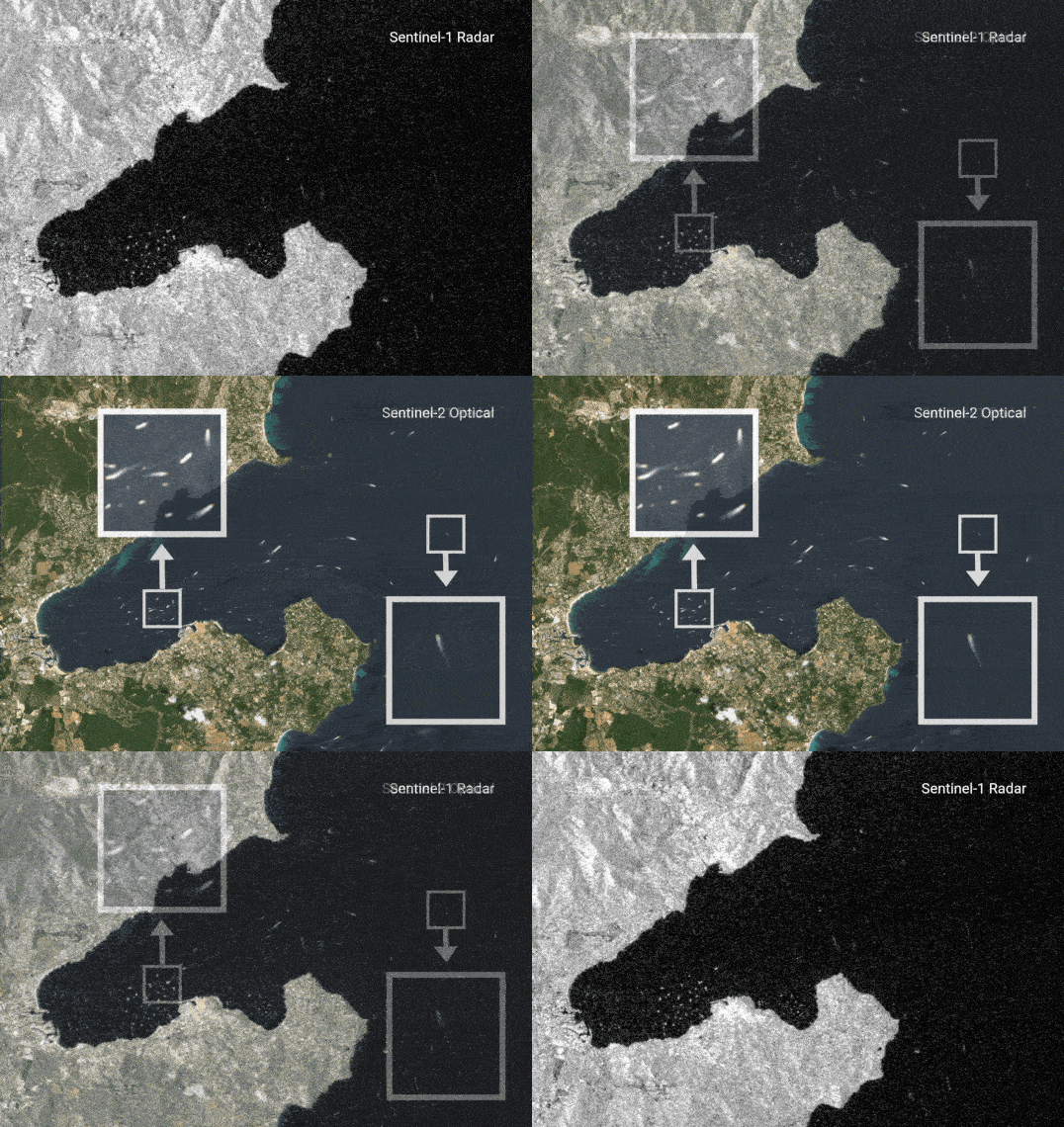
Black and white radar image showing a landmass extending into dark water, with rough textures indicating terrain; “Sentinel-1 Radar” is labeled in the top right corner.

A new dataset release features detections based on optical images from the European Space Agency’s Sentinel-2 satellites, which triple vessel detections and extend visibility to all coastal waters.
June
2025
Logo for the UN Ocean Conference Nice 2025 France, featuring a circular icon with multicolored segments and ocean wave symbols in the center, with event text on the right.

Our delegation shares our work throughout the conference, hosting and participating in side events focused on transparency, data-driven solutions and sustainable management of marine resources.
June
2025
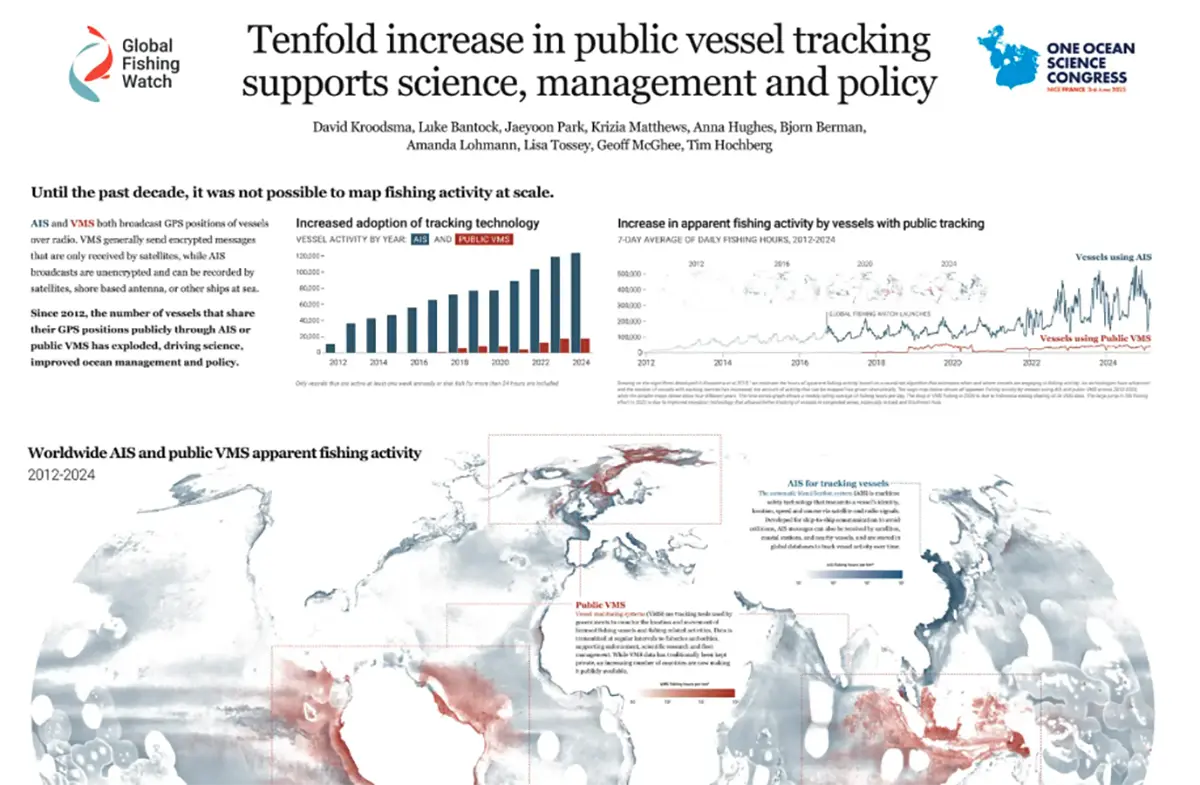
Infographic with charts, maps, and text showing a tenfold increase in public vessel tracking, with graphs of tracking growth, fishing activity, and world maps visualizing AIS and fishing activity data.

Chief scientist David Kroodsma presents a research poster highlighting how advances in vessel tracking technologies can support marine protection, enhance enforcement and inform evidence-based policy.
April
2025
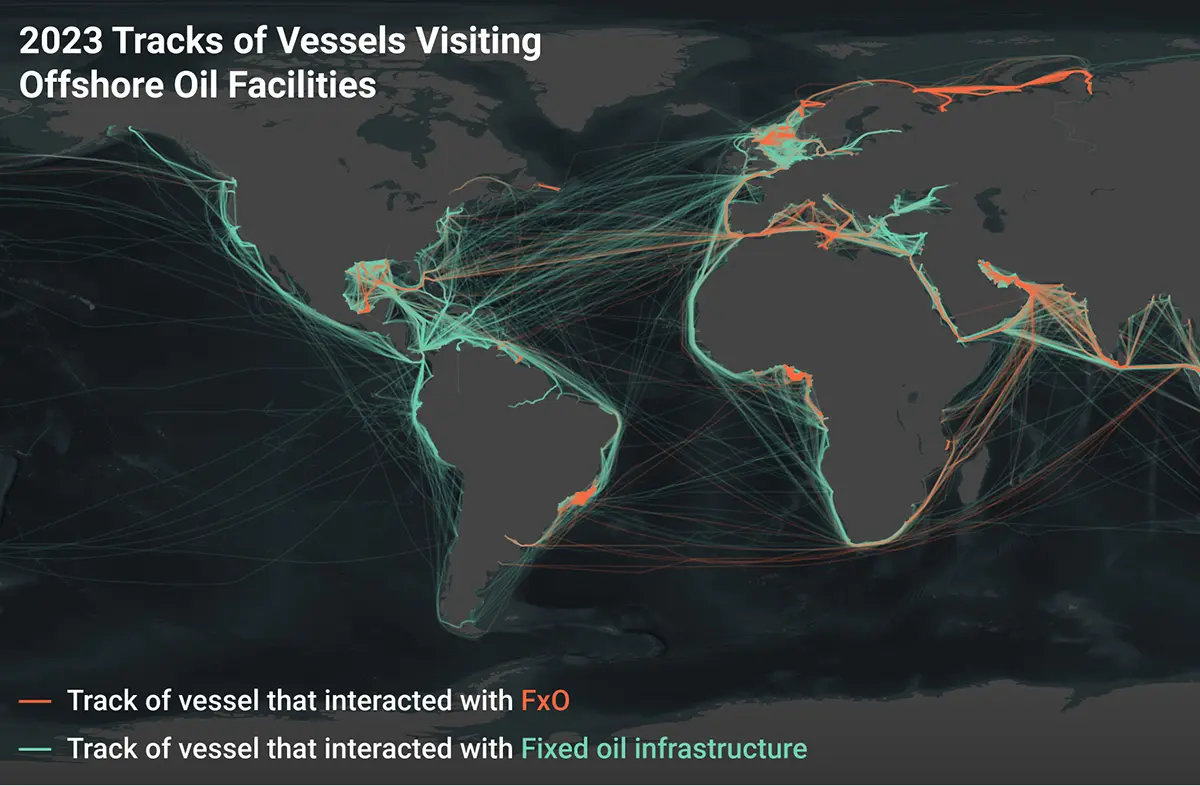
A dark world map showing 2023 vessel tracks visiting offshore oil facilities. Red lines indicate interaction with floating oil structures, and green lines show visits to fixed oil infrastructure. Text labels explain the color coding.

New satellite analysis reveals widespread pollution from offshore oil operations, threatening both the world’s ocean and climate.
April
2025
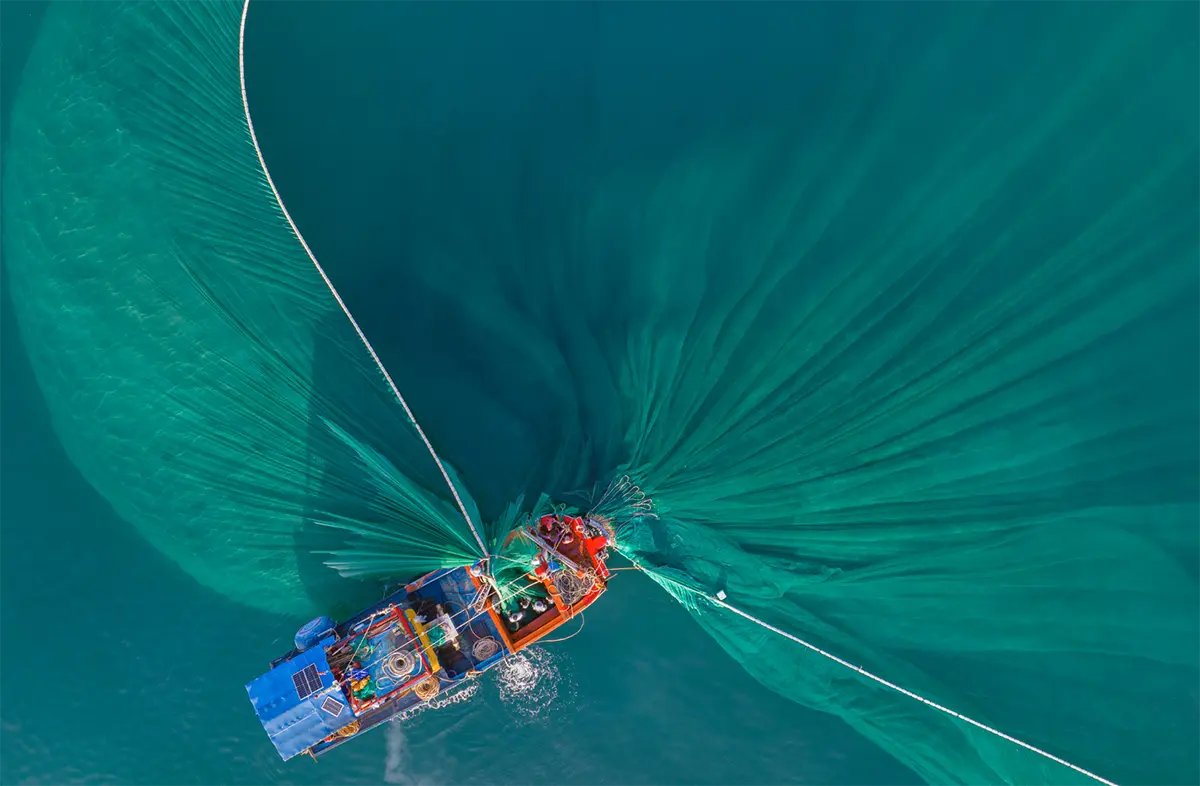
Aerial view of a fishing boat pulling large green nets through clear blue water, creating sweeping patterns on the waters surface.

The Organization for Economic Cooperation and Development formally adopts the recommendation on eliminating government support to illegal, unreported and unregulated fishing and recognizes the role of ultimate beneficial ownership transparency in achieving this objective.
March
2025
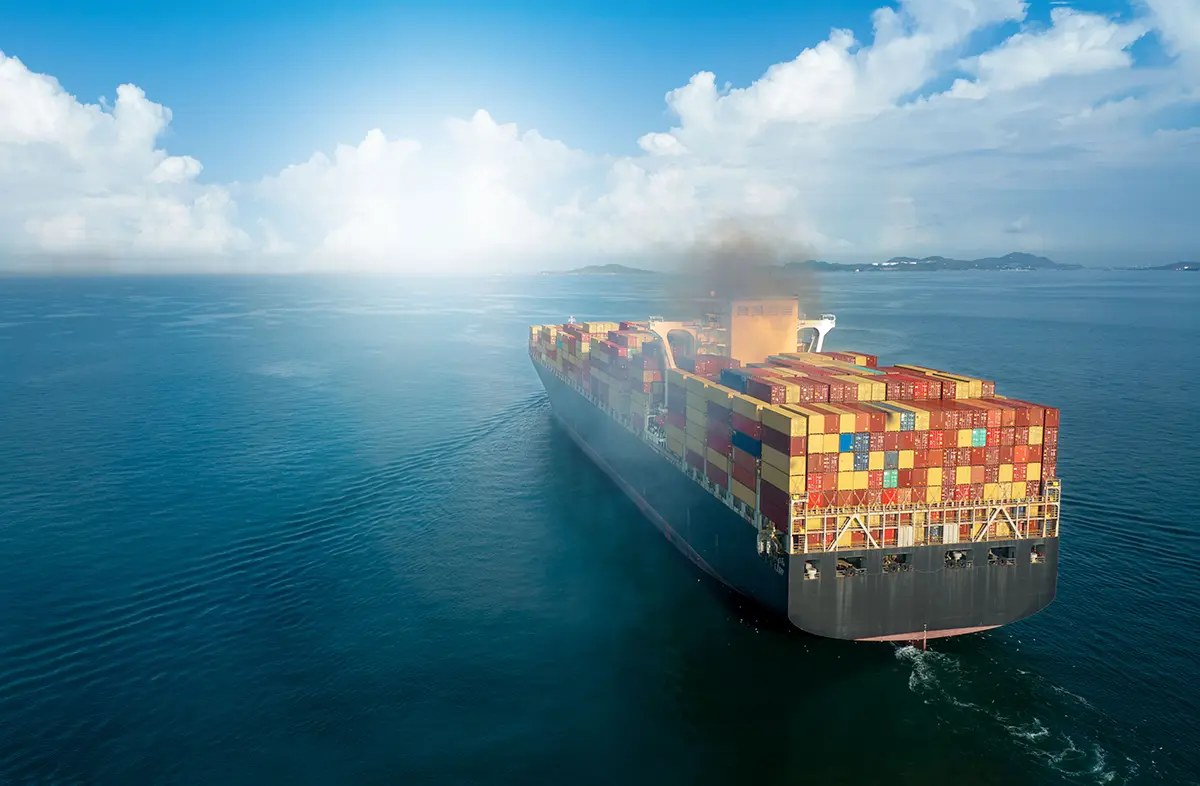
A large cargo ship loaded with colorful shipping containers sails on calm blue water under a bright, partly cloudy sky, with a trail of smoke rising from its smokestack.

This pilot study is the first to estimate the greenhouse gas emissions of all large industrial vessels operating in the ocean.
2025
December
2024

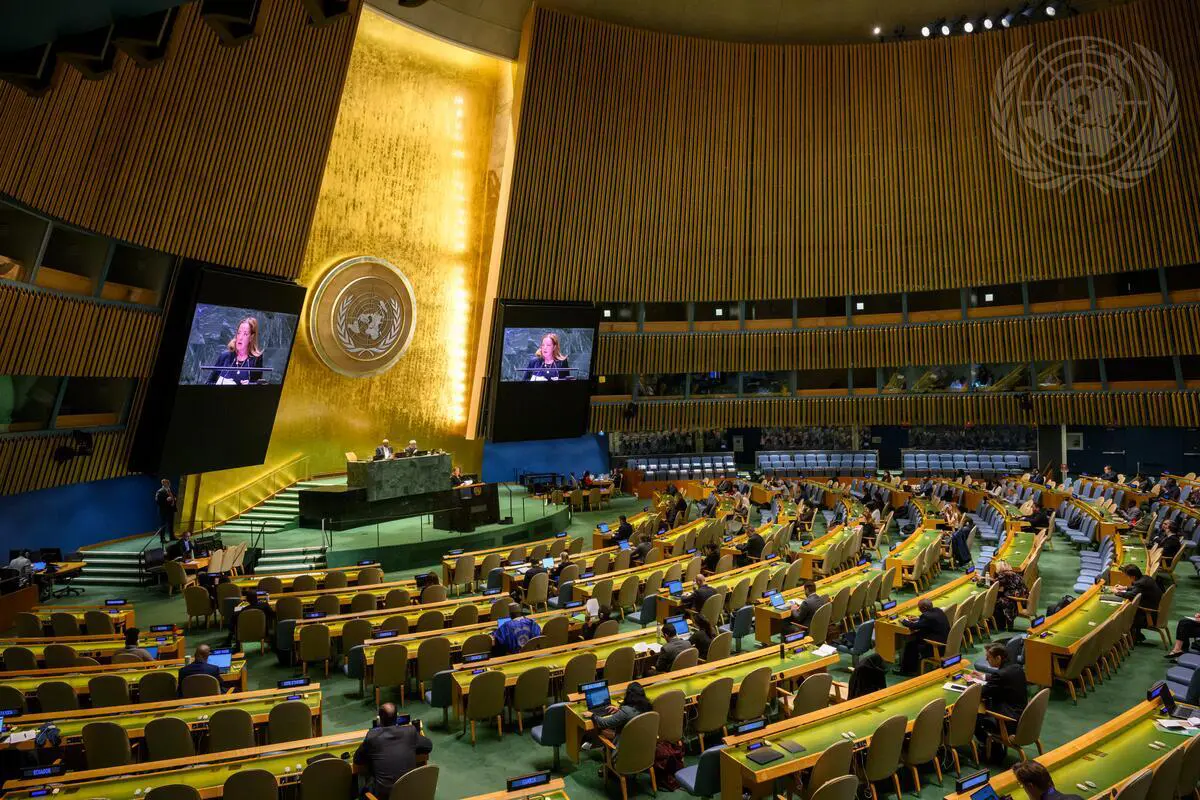
The United Nations General Assembly adopts a resolution on sustainable fisheries, hailed as a critical step in making transparency a “standard practice rather than an exception.”
January
2024

David Kroodsma, chief scientist at Global Fishing Watch, gives an overview of the groundbreaking study that used machine learning and satellite imagery to create the first global map of large-vessel traffic and offshore infrastructure.

January
2024
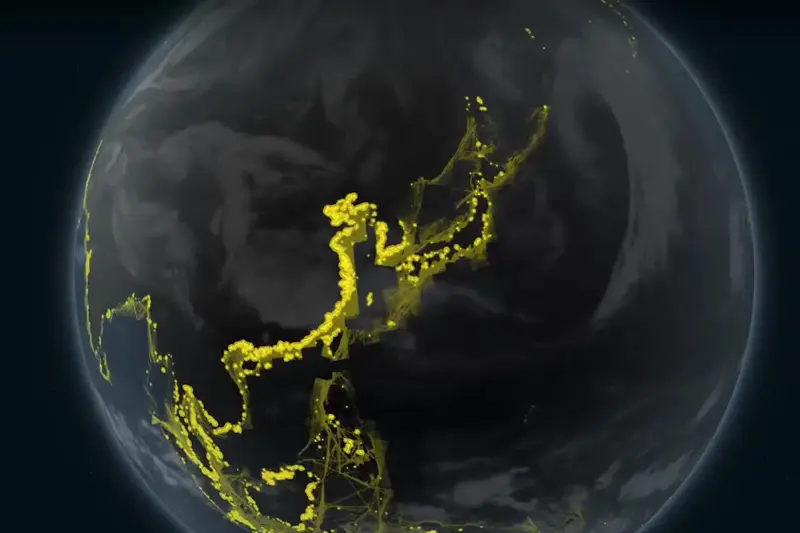
Dark globe showing East Asia with bright yellow network lines highlighting countries like Japan.

Satellite imagery, vessel GPS data and machine learning have been used to analyze millions of gigabytes of data to provide a first-of-its-kind snapshot of industrial activity at sea, published in the journal Nature.
2024
June
2023
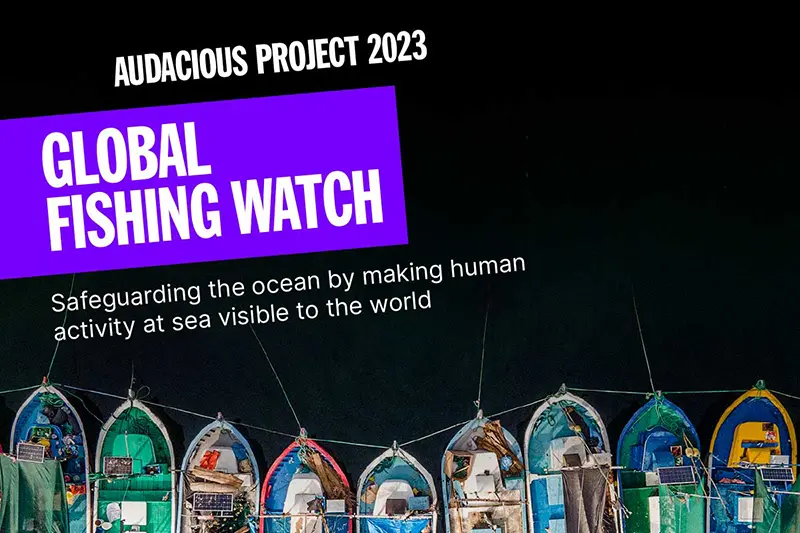
A row of fishing boats viewed from above at night with text: Audacious Project 2023, Global Fishing Watch, and Safeguarding the ocean by making human activity at sea visible to the world.

A five-year USD $60 million funding commitment has been made to catalyze a new initiative to apply AI and satellite data to help end illegal fishing and safeguard the ocean.

April
2023

Global Fishing Watch CEO Tony Long takes the TED stage to share our vision for mapping all industrial human activity at sea and making it freely available to the world.

Let's get Audacious!

The Audacious Project, housed at ​​TED—a nonprofit media organization dedicated to sharing ideas worth spreading—is a collaborative funding initiative catalyzing social impact on a grand scale. Each year they select and nurture a group of big, bold solutions to address the world’s most urgent challenges and, with the support of an inspiring group of donors and supporters, come together to get them launched. We are proud to be one of those big, bold solutions. With a $60 million investment through The Audacious Project, we are leveraging open data and emerging technology to revolutionize global ocean management. 

Big, bold ideas can’t succeed in isolation. If you want to contribute, participate or just learn more, we would love to hear from you. Get in touch!

Related Experts

Paul Woods GFW
Paul Woods

Paul Woods is co-founder and chief innovation officer of Global Fishing Watch, serving as the principal architect of the technology platform.

David Kroodsma GFW
David Kroodsma

David Kroodsma leads the research team, which includes data scientists and machine learning engineers and research partners around the globe.
Global Fishing Watch at a Glance

We believe information about the ocean should be common knowledge. We create and publicly share knowledge about human activity at sea to enable fair and sustainable use of our ocean. We make that information available to anyone with the goal of accelerating science and driving fairer, smarter policies that reward good behavior and protect biodiversity and livelihoods.

The Global Fishing Watch map has allowed stakeholders to gain insights into how vessels behave, or misbehave, at sea. Turning data into action, needs eyes in the sky and feet on the ground. We seek to sustain and scale our impact, and grow the global community harnessing technology to revolutionize ocean stewardship.

Scroll to Top